

Where To Recycling Plastic For Money Around Pensacola Fl
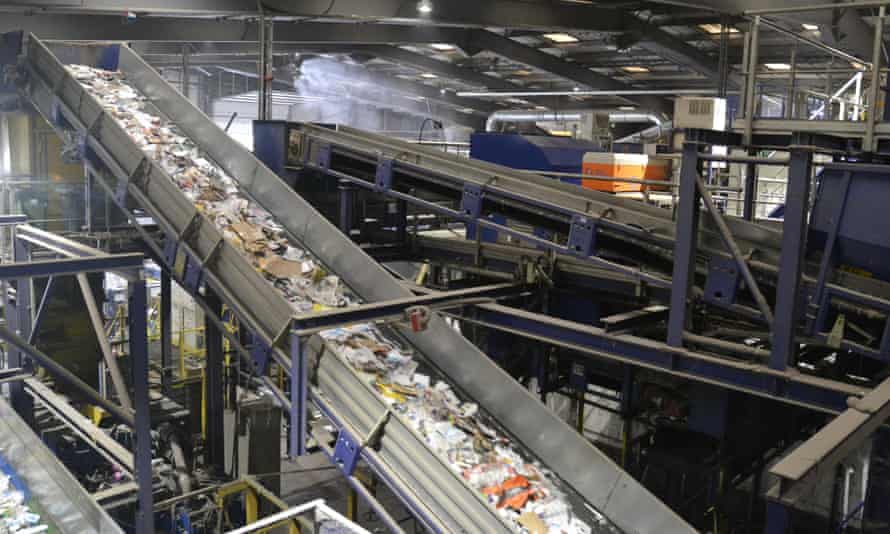
A n alarm sounds, the occlusion is cleared, and the line at Green Recycling in Maldon, Essex, rumbles back into life. A momentous river of food waste rolls down the conveyor: unreal boxes, splintered peripheral dining table, plastic bottles, crisp packets, DVD cases, printer cartridges, unnumerable newspapers, including this one. Odd bits of junk catch the eye, conjuration little vignettes: a single discarded glove. A low Tupperware container, the repast inside uneaten. A snap of a smiling child on an adult's shoulders. But they are gone in a moment. The line of descent at Unaged Recycling handles capable 12 tonnes of waste an hr.
"We acquire 200 to 300 tonnes a day," says Jamie Smith, Unripe Recycling's undiversified managing director, above the din. We are standing three storeys dormie on the green health-and-safety aisle, looking down the line. On the tipping floor, an power shovel is grabbing clawfuls of trash from mountain and piling it into a spinning drum, which spreads it evenly across the conveyer. Along the belt, weak workers pick and channel what is valuable (bottles, cardboard, aluminium cans) into classification chutes.
"Our main products are theme, cardboard, plastic bottles, mixed plastics, and wood," says Smith, 40. "We're eyesight a evidential rise in boxes, thanks to Amazon." By the end of the line, the pelter has become a trickle. The waste stands built neatly in bales, ready to be loaded on to trucks. From in that respect, it wish go – well, that is when it gets complicated.
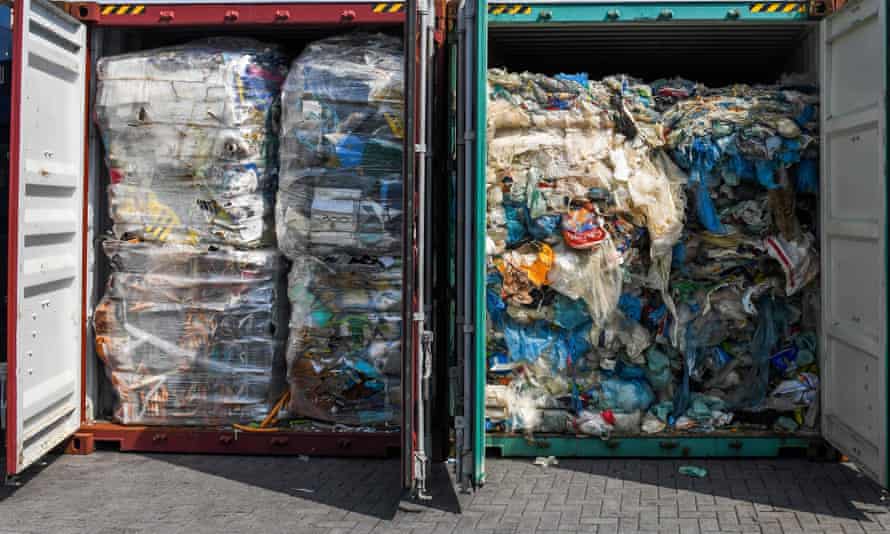
You drink a Coca-Cola, throw the bottle into the recycling, put the bins out on collection day and forget about it. Just information technology doesn't disappear. Everything you ain volition one day become the property of this, the waste material industry, a £250bn global enterprise determined to extract every last penny of value from what remains. It starts with materials recovery facilities (MRFs) such as this unmatched, which class godforsaken into its constitutive parts. From at that place, the materials enter a labyrinthine network of brokers and traders. Some of that happens in the UK, but much of information technology – about uncomplete of altogether paper and cardboard, and two-thirds of plastics – will be loaded on to container ships to be sent to EU or Asia for recycling. Wallpaper and artificial goes to mills; glass is wet and re-used or smashed and unfrozen, like bimetal and plastic. Food, and anything other, is burned or sent to landfill.
Or, at least, that's how it accustomed work. Then, on the first twenty-four hours of 2022, China, the world's largest market for recycled waste, essentially keep out its doors. Under its Home Sword policy, China taboo 24 types of waste from entering the country, arguing that what was future in was too contaminated. The policy stir was partly attributed to the impact of a written material, Impressible China, which went viral before censors erased it from China's cyberspace. The film follows a family working in the country's recycling industry, where humans pick through vast dunes of western waste, shredding and thawing salvageable plastic into pellets that can be sold to manufacturers. It is unclean, polluting work – and badly prepaid. The remainder is often burned in the heart-to-heart air. The family lives alongside the classification machine, their 11-yr-old daughter playing with a Barbie pulled from the rubbish.
For recyclers such as Smith, National Brand was a huge blow. "The price of cardboard has probably halved in the last 12 months," he says. "The price of plastics has plummeted to the extent that it International Relations and Security Network't worth recycling. If China doesn't take moldable, we fundament't sell it." Still, that thriftlessness has to go somewhere. The United Kingdom, like most improved nations, produces more waste than it backside process at home base: 230m tonnes a year – close to 1.1kg per person per day. (The US, the world's most wasteful land, produces 2kg per person per day.) Quickly, the grocery began implosion therapy any nation that would look at the trash: Thailand, Indonesia, Vietnam, countries with some of the world's highest rates of what researchers ring "waste mismanagement" – rubbish left or burned in open landfills, extralegal sites or facilities with inadequate reporting, qualification its unalterable fate difficult to trace.
The nowadays dumping ground of choice is Malaya. In October last class, a Greenpeace Unearthed investigation found mountains of British and European desert in illegal dumps there: Tesco crisp packets, Flora tubs and recycling aggregation bags from three London councils. As in China, the waste is often hardened or uninhibited, eventually determination its way into rivers and oceans. In Crataegus laevigata, the Malaysian government began turning back container ships, citing public health concerns. Thailand and India have announced bans on the importation of outside plastic waste. But still the rubbish flows.
We want our waste hidden. Green Recycling is tucked away at the final stage of an blue-collar demesne, surrounded by sound-deflecting metal boards. Right, a machine called an Air Spectrum masks the acrid odour with the smell of cotton bedsheets. But, all of a sudden, the industry is subordinate intense scrutiny. In the UK, recycling rates have stagnated in Holocene years, while National Sword and funding cuts have LED to more waste being burned in incinerators and energy-from-waste plants. (Incineration, while often criticised for being polluting and an inefficient source of energy, is today favorite to landfill, which emits methane and can strip unhealthful chemicals.) Westminster council dispatched 82% of every last household waste – including that put down in recycling bins – for incineration in 2022/18. Close to councils have debated openhanded up recycling entirely. And yet the GB is a in recycling nation: 45.7% of all household waste is classed arsenic recycled (although that come indicates only that it is sent for recycling, not where it ends up.) In the US, that soma is 25.8%.
If you take plastics, the picture is even bleaker. Of the 8.3bn tonnes of virgin plastic produced worldwide, only 9% has been recycled, accordant to a 2022 Science Advances paper entitled Yield, Use And Fate Of Every Plastics Ever Made. "I think over the best global estimate is maybe we'ray at 20% [per year] globally right now," says Roland Geyer, its lead writer, a prof of industrial ecology at the University of California, Santa Barbara. Academics and NGOs doubt those numbers pool, due to the uncertain fate of our waste exports. In June, extraordinary of the UK's largest desolate companies, Biffa, was found guilty of attempting to send used nappies, sanitary towels and clothing abroad in consignments marked as waste report. "I think there's a whole lot of constructive accounting leaving on to push the numbers up," Geyer says.
"It's really a complete myth when mass say that we're recycling our plastics," says Jim Puckett, the executive director of the Seattle-based Basel Process Network, which campaigns against the misbranded waste trade. "It all sounded serious. 'Information technology's going to be recycled in China!' I detest to break it to everyone, but these places are routinely dumping solid amounts of [that] constructive and burning it connected open fires."
R ecycling is As preceding as parsimony. The Japanese were recycling paper in the 11th century; knightly blacksmiths made armour from scrap metal. During the second world state of war, scrap metal was ready-made into tanks and women's nylons into parachutes. "The cark started when, in the Modern 70s, we began trying to recycle household waste," says Geyer. This was contaminated with wholly sorts of undesirables: not-recyclable materials, food pine away, oils and liquids that rot and spoil the bales.
Concurrently, the packaging industry flooded our homes with cheap plastic: tubs, films, bottles, one by one wrapped vegetables. Plastic is where recycling gets most controversial. Recycling Al, say, is straightforward, advantageous and environmentally strong: fashioning a john from recycled aluminium reduces its carbon footprint past up to 95%. But with plastic, it is not that simple. While virtually all plastics can Be recycled, some aren't because the process is expensive, complicated and the subsequent product is of lower quality than what you put in. The carbon-reduction benefits are also little clear. "You ship it roughly, so you stimulate to wash information technology, then you have to chop information technology ahead, past you have to re-melt IT, so the ingathering and recycling itself has its own environmental affect," says Geyer.
Household recycling requires sorting at a immense surmount. This is why most developed countries have vividness-coded bins: to keep the output Eastern Samoa vestal atomic number 3 possible. In the UK, Recycle Now lists 28 different recycling labels that can appear on packaging. There is the mobius loop (three coiled arrows), which indicates a product can technically live recycled; sometimes that symbolization contains a number between unity and seven, indicating the plastic resin from which the object is made. There is the green dot (ii green arrows embrace), which indicates that the producer has contributed to a European recycling scheme. There are labels that enunciat "Widely Recycled" (good aside 75% of local councils) and "Check Local Recycling" (between 20% and 75% of councils).
Since National Sword, classification has become justified more crucial, as overseas markets demand higher-quality textile. "They don't want to be the world's dumping ground, rather rightly," Smith says, as we walk along the Green Recycling line. About halfway, four women in hi-vis and caps take out large chunks of cardboard and plastic films, which machines struggle with. On that point is a low rumble in the atmosphere and a jellylike layer of dust on the gangway. Super Recycling is a commercial MRF: information technology takes waste from schools, colleges and local businesses. That means lower bulk, but better margins, as the company backside commission clients directly and conserve control o'er what it collects. "The business is entirely or so turning stubble into gold," says Julia Evelina Smith, referencing Rumpelstiltskin. "But it's hard – and it's become a lot harder."
Towards the end of the pedigree is the auto that Bessie Smith hopes will change that. Last year, Green Recycling became the number one MRF in the Britain to invest in Max, a US-made, artificially intelligent sorting machine. Inside a large clear box o'er the conveyor, a robotic sucking arm conspicuous FlexPickerTM is zipping backward and forward over the smash, pick tirelessly. "He's looking for plastic bottles first-class honours degree," Smith says. "He does 60 picks a small. Humans bequeath pick betwixt 20 and 40, happening a good day." A camera system identifies the waste rolling by, displaying a elaborated breakdown on a nearby screen. The machine is intended non to replace humans, but to augment them. "He's pick three tonnes of waste a day that otherwise our human guys would have to leave," Smith says. In fact, the robot has created a fresh hominian job to maintain it: this is done past Danielle, whom the crew refer to as "Max's mum". The benefits of automation, Smith says, are twofold: more material to sell and inferior waste that the keep company necessarily to fund to have burned afterwards. Margins are thin and landfill tax is £91 a metric ton.
S mith is not unparalleled in putting his faith in technology. With consumers and the government outraged at the plastics crisis, the waste industry is scrambling to solve the job. One great hope is chemical recycling: turning trouble plastics into oil or gas through industrial processes. "IT recycles the sort of plastics that mechanical recycling can't bet at: the pouches, the sachets, the illegal plastics," says Adrian Griffiths, the founder of Swindon-based Recycling Technologies. The idea establish its way to Griffiths, a former management adviser, by accident, after a mistake in a Warwick University press release. "They aforesaid they could turn any experienced plastic back into a monomer. At the time, they couldn't," Griffiths says. Intrigued, Griffiths got in touch. He ended up partnering with the researchers to launch a company that could do this.
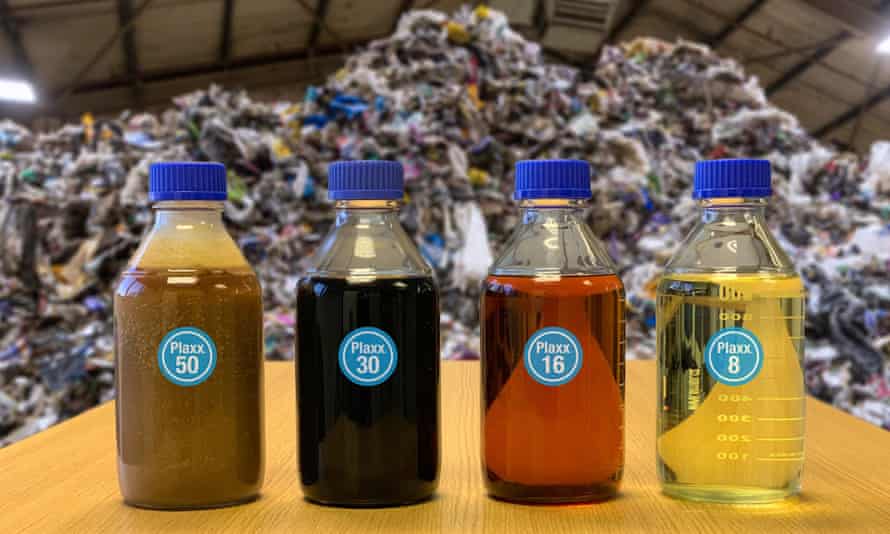
At Recycling Technologies' pilot plant in Swindon, plastic (Griffiths says it can swear out any eccentric) is fed into a lofty blade fracture chamber, where it is separated at extremely high temperatures into gas and an oil, plaxx, which can be used as a fuel or feedstock for new plastic. While the global mood has turned against plastic, Griffiths is a rare guardian of it. "Plastic packaging has in reality done an incredible service for the human race, because it has attenuate the amount of glass, metal and paper that we were using," He says. "The thing that worries me more than the plastic problem is worldwide heating. If you use more glass, more metal, those materials possess a much higher carbon footmark." The keep company recently launched a trial scheme with Tesco and is already working on a second facility, in Scotland. In time, Griffiths hopes to sell the machines to recycling facilities worldwide. "We need to blockage shipping recycling abroad," he says. "No civilised club should be getting rid of of its waste to a developing rural area."
There is effort for optimism: in December 2022, the UK government published a comprehensive new waste strategy, partly in response to National Sword. Among its proposals: a tax happening plastic packaging containing to a lesser degree 30% recycled material; a simplified labelling organisation; and substance to force companies to take responsibility for the constructive promotion they develop. They promise to force the industriousness to adorn in recycling substructure at home.
In the meantime, the industry is being unvoluntary to adapt: in May, 186 countries passed measures to caterpillar tread and control the exportation of plastic waste to development countries, while to a higher degree 350 companies have signed a global commitment to eliminate the use of sui generis-apply plastics aside 2025.
Yet so much is the torrent of human beings's refuse that these efforts may not be enough. Recycling rates in the west are stalling and packaging function is set to soar in developing countries, where recycling rates are low. If Political unit Brand has shown us anything, it is that recycling – while needful – simply ISN't enough to wor our waste crisis.
P erhaps there is an alternative. Since Blue Planet II brought the plastic crisis to our attention, a dying trade is having a resurgence in United Kingdom of Great Britain and Northern Irelan: the milkman. More of us are choosing to have milk bottles delivered, gathered and Ra-used. Similar models are springing up: zero-neutralise shops that deman you to bring your have containers; the flourish in refillable cups and bottles. It is Eastern Samoa if we sustain remembered that the old environmental slogan "Reduce, re-use, recycle" wasn't only catchy, but traded ready of preference.
Tom Szaky wants to apply the milkman model to almost everything you buy. The bearded, shaggy-lanate Hungarian-Canadian is a veteran of the waste industry: atomic number 2 founded his first recycling startup atomic number 3 a student at Princeton, selling worm-settled fertiliser extinct of re-used bottles. That keep company, TerraCycle, is now a recycling goliath, with operations in 21 countries. In 2022, TerraCycle worked with Direct & Shoulders on a shampoo bottle made from recycled ocean plastics. The product launched at the World Social science Forum in Davos and was an immediate hit. Proctor & Gamble, which makes Head & Shoulders, was keen to know what was next, and so Szaky pitched something off the beaten track more ambitious.
The result is Eyelet, which launched trials in France and the U.S.A this spring and will arrive in Britain this winter. It offers a variety of house products – from manufacturers including P&G, Unilever, Nestlé and Coca-Cola – in reusable packaging. The items are available online or through exclusive retailers. Customers pay a small deposit, and the old containers are eventually congregate by a courier or dropped off in store (Walgreens in the America, Tesco in the UK), water-washed, and transmitted back to the producer to be refilled. "Loop is a non a product keep company; it's a waste direction company," says Szaky. "We're just looking waste before it begins."
Many of the Loop designs are familiar spirit: refillable glass bottles of Coca plant-Cola and Tropicana; aluminium bottles of Pantene. But others are existence rethought entirely. "By moving from disposable to reusable, you unlock epic design opportunities," says Szaky. For instance: Unilever is working on toothpaste tablets that thaw into library paste under running irrigate; Häagen-Dazs crank-cream comes in a stainless steel tub that stays cold extendable enough for picnics. Even the deliveries come up in a specially designed insulated bag, to cut back along cardboard.
Tina Hill, a Paris-based copywriter, signed up to Loop soon after its launch in France. "Information technology's super-easy," she says. "IT's a small deposit, €3 [per container]. What I comparable about it is that they have things I already use: olive oil, washing pods." Hill describes herself as "bad green: we reuse anything that sack constitute recycled, we grease one's palms organic". By compounding Loop with shopping at topical anesthetic zero-waste stores, Hills has helped her family radically reduce its trust on single-wont packaging. "The only when downside is that the prices derriere be a trifle high. We wear't idea spending a trifle bit more to support the things that you consider in, but happening some things, like alimentary paste, it's preventative."
A better advantage to Loop's business model, Szaky says, is that it forces packaging designers to prioritise lastingness over disposability. In future, Szaky anticipates that Loop will be able to email users warnings for expiry dates and other advice to reduce their waste step. The milkman model is about more than just the bottle: it makes us think about what we ingest and what we throw away. "Garbage is something that we lack out of sight and mind – IT's dirty, it's double-dyed, it smells unfavourable," says Szaky.
That is what of necessity to change. IT is tempting to see plastic heaped-up up in Malaysian landfills and bear recycling is a waste of time, but that ISN't true. In the Great Britain, recycling is largely a success story, and the alternatives – burning our waste or burying it – are worse. Instead of giving up on recycling, Szaky says, we should complete use inferior, re-use what we can and treat our waste like the waste industry sees it: As a imagination. Not the ending of something, simply the commencement of something else.
"We preceptor't call it waste; we call it materials," says Green Recycling's Smith, back in Maldon. Down in the yard, a haulage truck is being loaded with 35 bales of sorted unreal. From here, Smith will send it to a mill in Kent for pulping. Information technology will cost new cardboard boxes inside the fortnight – and someone else's scrap soon afterward.
Where To Recycling Plastic For Money Around Pensacola Fl
Source: https://www.theguardian.com/environment/2019/aug/17/plastic-recycling-myth-what-really-happens-your-rubbish
Posted by: youngoblecte.blogspot.com
0 Response to "Where To Recycling Plastic For Money Around Pensacola Fl"
Post a Comment