

Internet for All
Since its nascency in the labs of ARPANET one-half a century back, Internet has risen to create a truly global communication system connecting people across the world. The last ii decades has seen users rising from twoscore meg to around iii billion, with one billion added in the concluding four-five years itself. This exponential growth is fueled primarily by three factors: a robust and resilient global network, growth of cheaper and powerful computing driven by the Kurzweil curve and an ecosystem of relevant services created by new companies powered by network furnishings.
The Elephant in the Room
Editor's Annotation:
Guest writer Vignan Velivela is interested in parallel universes, internet access, electrical cars and make clean energy. Follow him @vignanv8
Over 4 billion people notwithstanding remain unconnected to the Cyberspace. Users today are predominantly urban since vast majority of investments by telecom manufacture went into solving the problem of capacity and complication while not investing plenty on last mile admission. Case in point, the The states. Over 10 million have no admission and 17% of its population (incl. over one-half of rural Americans) lack quality broadband access. The problem is not just economic (lower rural revenue, higher capex) every bit often argued, merely also because of technological limitations. In a developing country such every bit India, this problem is compounded by lack of reliable back up infrastructure (like grid ability).
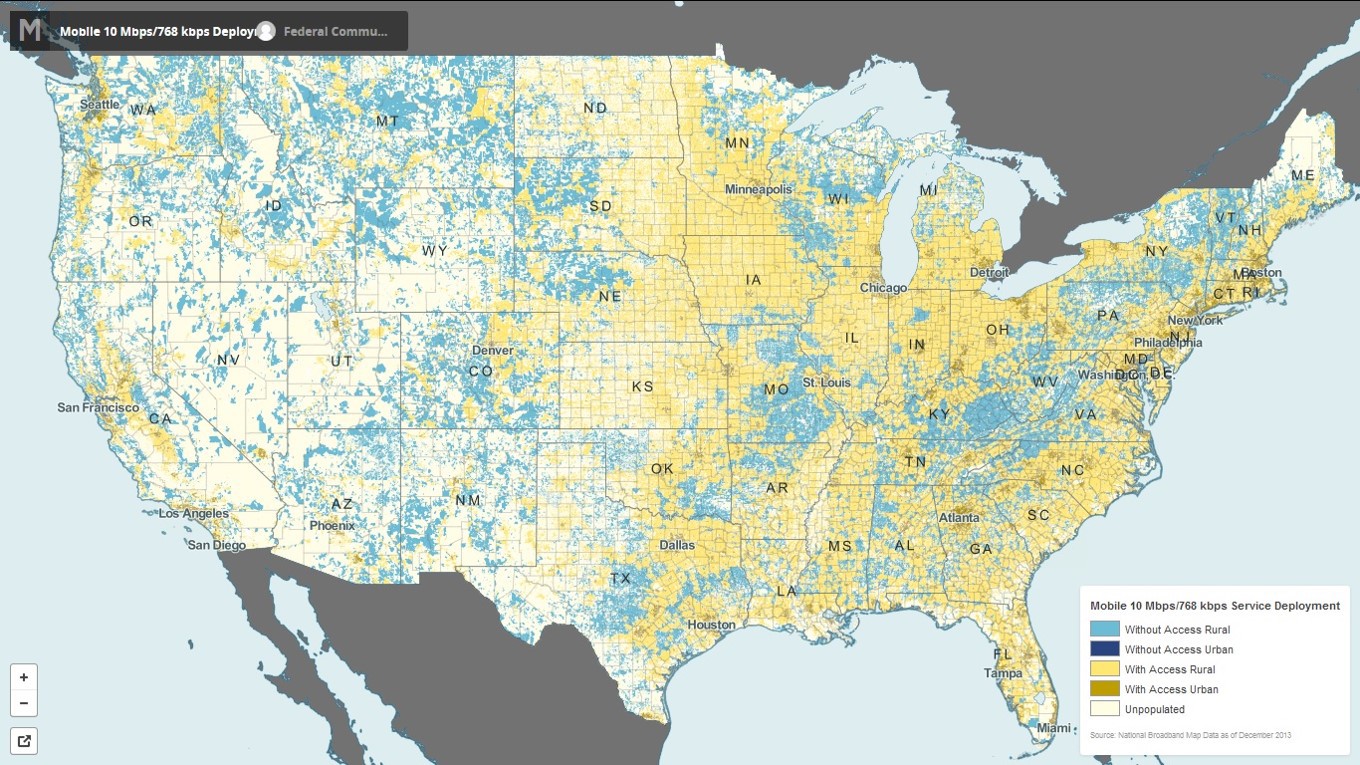
The states Mobile Broadband Map. Source: 2022 Broadband Progress Report, United states of america FCC
To solve the terminal mile connectivity trouble, nosotros must pattern a network with the end user in listen. Smartphones today provide the lowest betoken of entry ($30–35 Android) to the Internet and over a billion of them are being produced annually. To bring the next four billion people on to the Internet in the next few years, wireless (3G/LTE/WiFi) should act as the main access network.
Solutions
Governments and Internet majors have been pursuing multiple-approaches to solve this problem.
Google with its Project Loon is creating a worldwide network of high-altitude balloons which would connect directly to a user's smartphone through 3G and LTE. These balloons have an reward of elevation, significant each balloon can cover an expanse of 5000 sqkm dissimilar a cell belfry which covers around five-10 sqkm. These balloons can now communicate among themselves for as long equally 80 km and in chains of x, meaning not a lot of investment in telecom backhaul and ground stations are needed. Although these balloons are difficult to navigate since they rely only on stratospheric winds, it is a fun problem to solve. As Google is perfecting WiFi to cellular handoffs with Projection Fi, its new role equally an MVNO (virtual network), balloons and drones (Titan) may play a crucial office in its roaming success.
Facebook through their Connectivity lab is developing stratospheric drones which would use a mix of light amplification by stimulated emission of radiation and radio links to connect to basis receivers and too create an aerial drone-based backhaul network. Drones of Facebook are still in prototyping stage and details of their delivery model is not yet bachelor in public domain.
Another method is to use White Space to provide broadband services espl. in rural areas. White Space is the costless and unused spectrum that's increasing as TV broadcasting moves from analog to digital transmission. Manual happens over UHF spectrum, significant towers tin can be spaced at longer distances (10km). But phone/tablet users cannot connect directly (notwithstanding) and have to rely on WiFi hubs which can receive these signals. Google and Microsoft (4Afrika Initiative) are two of the major companies who are testing this applied science with a focus on Africa.
Case for Satellite Net

1945 Proposal of Arthur C. Clarke for Geostationary Satellite Communications. Source: lakdiva.org
A promising new approach to connectivity is by the proposed small satellite constellations of SpaceX, OneWeb, LeoSat and Yaliny. These satellites would be in low earth orbit altitudes (around thou–1200 km) meaning the latency of their connection would be similar to fiber (< 30ms). Current satellite Internet services take high latencies (>300ms) due to the distant location of their satellites (Geostationary — 35786km).
Although non all Internet applications need depression latencies, it is crucial for advice services like VoIP, messaging and transactional services like banking. Too, satellites would need far fewer hops to connect to international CDNs compared to fiber-based networks, significant countries in Africa where most cobweb connections still have very high latency tin at present be serviced with faster connections.
At the receiver end, OneWeb and SpaceX are developing depression-cost (USD 100–300), solar-powered transceivers which would provide 3G, LTE and WiFi connectivity to local communities.

CubeSats of Planet Labs deployed from the ISS for Earth Imaging. Source: Steve Jurvetson/Flickr
OneWeb has a constellation size of 648 satellite with a combined throughput of 10Tbps. Each OneWeb satellite can cover an area of approx. 800,000 sq.km. and each transceiver tin can provide services at upward to 50Mbps. SpaceX has a more aggressive program of launching around 4000 satellites starting 2022 till 2030, predominantly to serve the International backhaul market which today operates on a network of undersea cables carrying over 95% of the international traffic. Yaliny is developing a handheld satellite transceiver which would connect to the user and provide unlimited information at $10 per month. LeoSat is primarily targeting enterprise customers such every bit Telecom backhaul, Defence, Oil&Gas and would evangelize bandwidth as high every bit 1.2 Gbps.
Airbus was awarded the contract to build OneWeb'south 900 satellites. Source: Airbus (Youtube)
Many Satellite-based Internet ventures were proposed in the 90's which eventually failed due to limitations of technology and fast proliferation of terrestrial networks. Primal innovations in satellite miniaturization, phased array antenna (electronically-steered) and solid state amplifiers (GaN) are making these constellations technologically and economically feasible now. Also, the increase in availability and reduction in costs of launch services for small satellites provided by private space companies is accelerating these ventures. Developing rapidly reusable rockets, similar SpaceX Falcon 9R, would improve availability and cutting costs further by orders of magnitude (10 to 100 times). These ventures accept also attracted meaning investor interest with SpaceX raising $1 billion from Google and Fidelity and OneWeb raising $500 one thousand thousand from a consortium of investors.
Two of import issues that ingather up on the regulatory front are spectrum allotment and landing rights. OneWeb has been granted the global license to operate in the non-Geo Ku-band by the ITU if they become operational by 2022. But it isn't clear how new satellite constellations would exist allotted such spectrum while operating relatively free of interference. SpaceX'south awarding for permission from the US FCC to exam ii of its satellites has already drawn objections from Intelsat. On the issue of landing rights, OneWeb would be partnering with domestic telecom operators using their ground stations and gateways to axle Net, therefore they may not face up many domestic regulatory road blocks. It is not articulate at this indicate how SpaceX would be delivering their services to the finish user. Yaliny is perhaps most prone to governmental scrutiny since they would be operating based on a network of international ground stations.
India
In India, the second largest telecom market, Cyberspace penetration is estimated to be still around twenty% although rural and urban teledensity stand at 45% and 148% respectively. Over 90% of Indian Internet users connect to and 65% of the traffic flows through wireless networks. These numbers are no unlike compared to sub-Saharan Africa because telecom networks in developing nations today are predominantly built for vocalization (2G) and not data communications. Although average revenue per user (ARPU) in rural ($1.5) and urban ($2–2. 5) areas do vary, lack of connectivity tin exist attributed majorly to high CapEx (costly backhaul) and OpEx (off-grid diesel ability) of existing technologies.
The Govt of India is developing BharatNet as part of the Digitial India program, a revamped and larger version of the National Optical Fiber Network (NOFN) which plans on providing fiber optic connectivity to nigh of the 2.5 lac Gram Panchayats (moderate size villages). The projected toll of the project stands at $ 12 Billion with around 75% cost going into laying the optical fiber to connect ii.26 lac GPs. Of the rest, 20 grand GPs would be connected wirelessly and 3000 through satellite Cyberspace. At the hamlet level, customs WiFi would be provided to local institutions such as schools, postal service offices, wellness centers along with cable Internet to households.
The Government can take proactive steps to augment the capacity and reach of BharatNet by post-obit open standards in integrating them with private Internet ventures to ensure interoperability. ISRO, India's national space agency, can launch more Geostationary satellites (like the INSAT) to increase the throughput over its territory. This would allow traffic to be diverted from low distance systems for applications such as video, news and less interactive content which wouldn't need low latency connections. These Geostationary satellites can too be used to empower customs divers broadcasting services like Outernet. Other models such every bit edifice modest satellite platforms in highly elliptical orbits (like Molniya) can be explored to meliorate performance over specific regions.
Possibilities
Internet is the about of import invention of the 20th Century. It has changed the style people communicate, cooperate, larn and trade globally. The possibilities with a ubiquitous Internet coverage are countless. Let's hash out four key areas which would take direct and positive effect: healthcare, education, agriculture and Internet governance.
Innovations in sensors and calculating are rapidly miniaturizing and reducing costs of diagnostic devices and new drone-based delivery networks (Matternet) are making medicines more accessible, meaning early detection and fast remedial actions can now be made universal. As Chris Anderson would argue, this is the peace dividend of the smartphone wars.
Education will confront a similar disruption when the all-time educators in the world can reach a virtual classroom of hundreds of thousands of students while also personalizing their learning feel. Although some may oppose the notion of machines teaching humans, it is inevitable.

Source: I Laptop Per Child/Flickr
Pocket-sized satellites (like those of Planet Labs, Skybox) are democratizing satellite imagery, pregnant agronomics produce, environment, disasters among others tin can now be monitored in near existent time. Smart tools tin exist built for farmers beyond the earth to provide accurate conditions and toll forecasts and so as to ameliorate their productivity and income.

Source: Planet Labs
Peter Diamandis opens his volume Abundance with a story on aluminum. When the King of Siam visited Napoleon 3's court, Napoleon was himself served in gold utensils while the honored invitee was served in aluminum utensils. Although the third almost abundant element on earth's chaff, aluminum was the costliest metal till 19th century. With the invention of electrolysis, we could brand aluminum i of the cheapest and most accessible metal today. The conflict over cyberspace neutrality arose primarily because bandwidth has been perceived as a scarce resource. Exponential innovation tin create abundance through a combination of cheap smartphones and global connectivity allowing us to avert such conflict.
Never before in human history could we expand our circle of empathy and develop a collective consciousness encompassing the whole of humanity.
This could be our first adventure!

Source: https://www.techspot.com/article/1053-internet-for-all/
Posted by: youngoblecte.blogspot.com
0 Response to "Internet for All"
Post a Comment